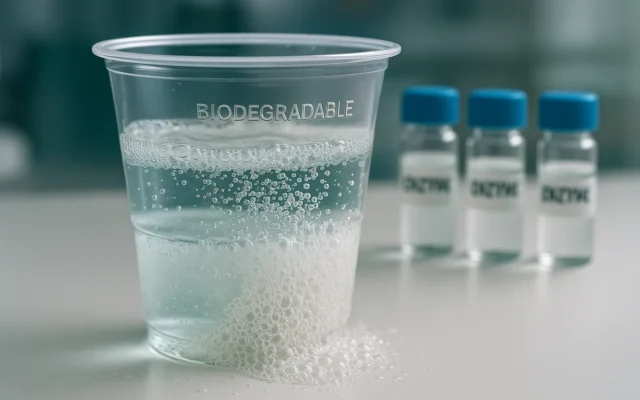
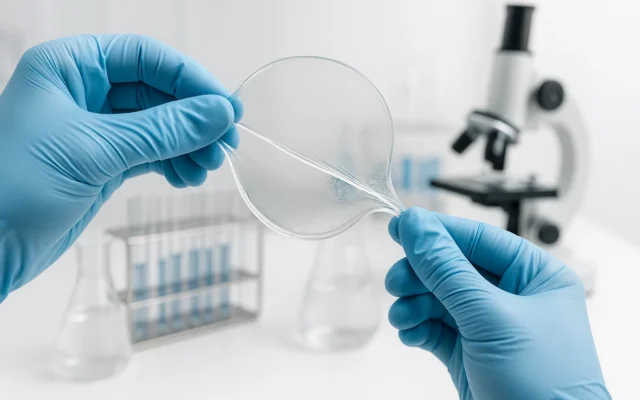
Plastic alternatives that need farmland or freshwater trade one problem for another. Algae bioplastics avoid both, using microalgae and cyanobacteria to produce polymers that are renewable, biodegradable and, increasingly, commercially real.
A review in Environmental Science and Pollution Research (Mogany et al., 2024) maps the global state of algal bioplastic research and finds a field well past the laboratory stage.
How algae become plastic
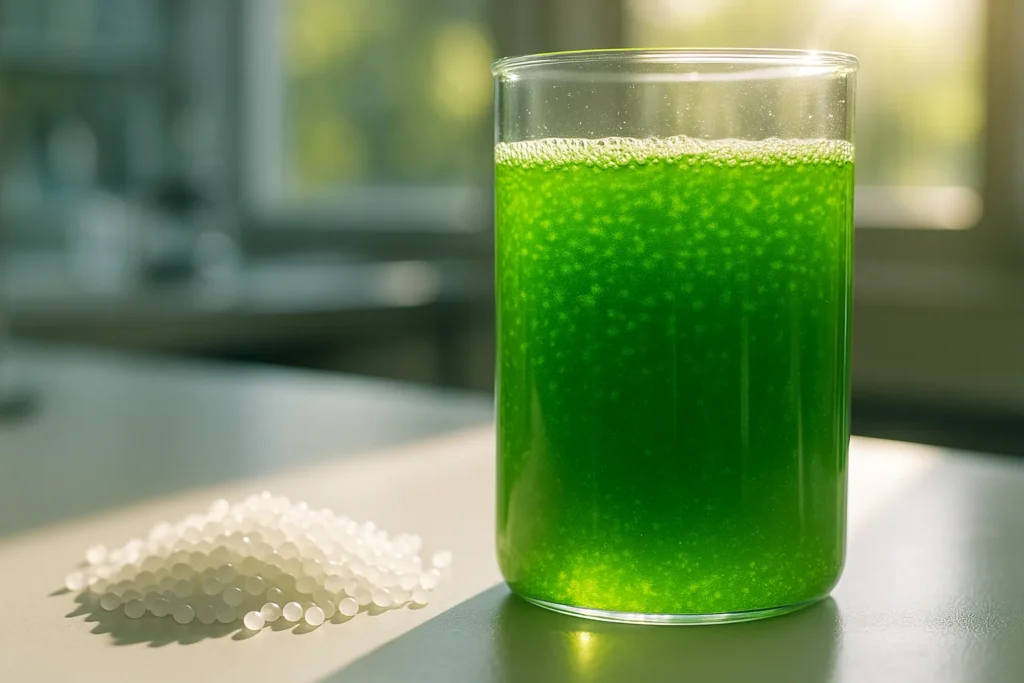
Microalgae and cyanobacteria accumulate polymers inside their cells naturally, including polyhydroxyalkanoates (PHAs) and starch-like compounds. Those biopolymers are extracted and processed into films, pellets and molded products for packaging, agriculture and consumer goods.
The cultivation is the advantage. Algae grow in saltwater, in wastewater or on non-arable land, so none of the food-versus-fuel argument that dogged first-generation bioplastics applies.
How large the field has got
Mogany, Bhola and Bux count roughly 55 patents since 2011 and about 81 entities worldwide producing or developing algal bioplastic products. That is a sector with commercial participants, not a research topic.
A 2025 commentary in Nature Biotechnology (“Ocean-grown bioplastics,” 2025) makes the wider case: ocean-cultivated feedstock could reshape polymer supply chains while supporting marine ecosystem management rather than competing with it.
What algae-based materials offer
- No freshwater or arable land required for cultivation
- Carbon-negative potential because algae absorb CO2 during growth
- Biodegradable end products that break down in natural environments
- Alignment with UN Sustainable Development Goals, particularly SDG 12 (Responsible Consumption and Production) and SDG 14 (Life Below Water)
What is holding it back
Cost, mostly. Production still runs above petroleum plastics, and scaling cultivation to industrial volume takes serious capital. Downstream processing adds its own difficulty, since extracting and purifying the polymer is neither cheap nor simple.
Standardization is the quieter obstacle. Without consistent material specifications and certification routes, no manufacturer will commit an algae-based feedstock to a high-volume product line.
What changes the economics
Two things. Genetic engineering is raising polymer yields per strain, and biorefinery models are pairing bioplastic production with biofuels and nutraceuticals so that one cultivation run supports several products. Public funding for sustainable materials research is rising alongside both.
For anyone sourcing packaging or product materials with a defensible sustainability story, algae bioplastics are worth tracking, because the feedstock competes with nothing.
FAQ
What are algae bioplastics made from?
They are made from polymers such as polyhydroxyalkanoates (PHAs) and polysaccharides that microalgae and cyanobacteria naturally produce inside their cells.
Are algae bioplastics biodegradable?
Yes. Most algae-based bioplastics are fully biodegradable in natural environments, including soil and marine settings.
How many companies produce algae bioplastics?
According to a 2024 review, approximately 81 entities globally are involved in the production or development of algal bioplastic materials.
Do algae bioplastics compete with food crops?
No. Algae can be grown in saltwater, wastewater, or on non-arable land, so they do not compete with agricultural food production.