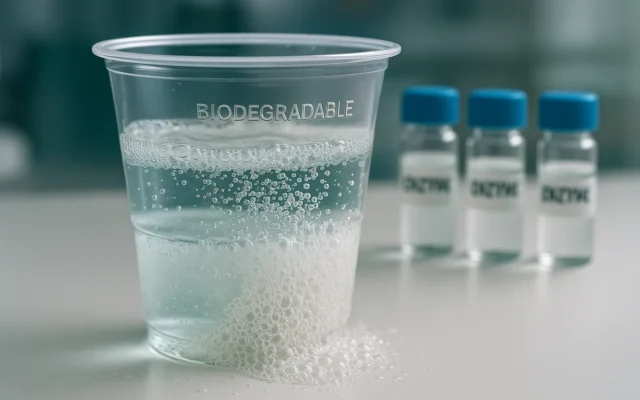
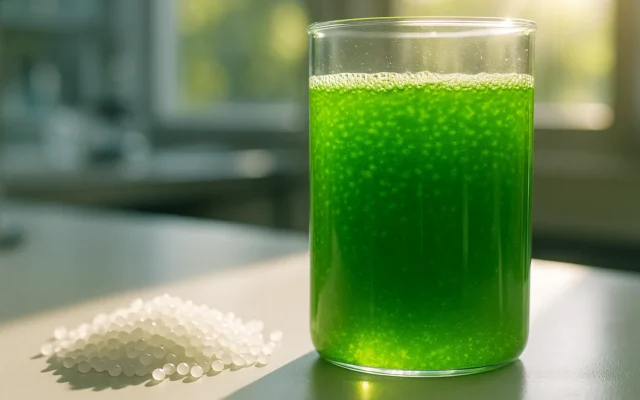
A new family of DNA bioplastics crosslinks plant-derived polysaccharides with DNA from natural sources to make hydrogels that biodegrade, recycle in plain water and repair themselves. The study by Ke, Lan and Wong (2025) in Nature Communications describes a water-based route to bioplastic that needs no solvents and no heat.
How the hydrogels work
Three common polysaccharides do the structural work: dextran, alginic acid and carboxymethyl cellulose. DNA crosslinks them through reversible imine bond formation, and that reversibility is where the material’s properties come from.
Because the crosslinks can be undone, simple aqueous hydrolysis takes the plastic apart for recycling. Water is the only reagent. No harsh solvents, no elevated temperatures.
What the material does
- Water-processable: manufactured and recycled using water-based processes
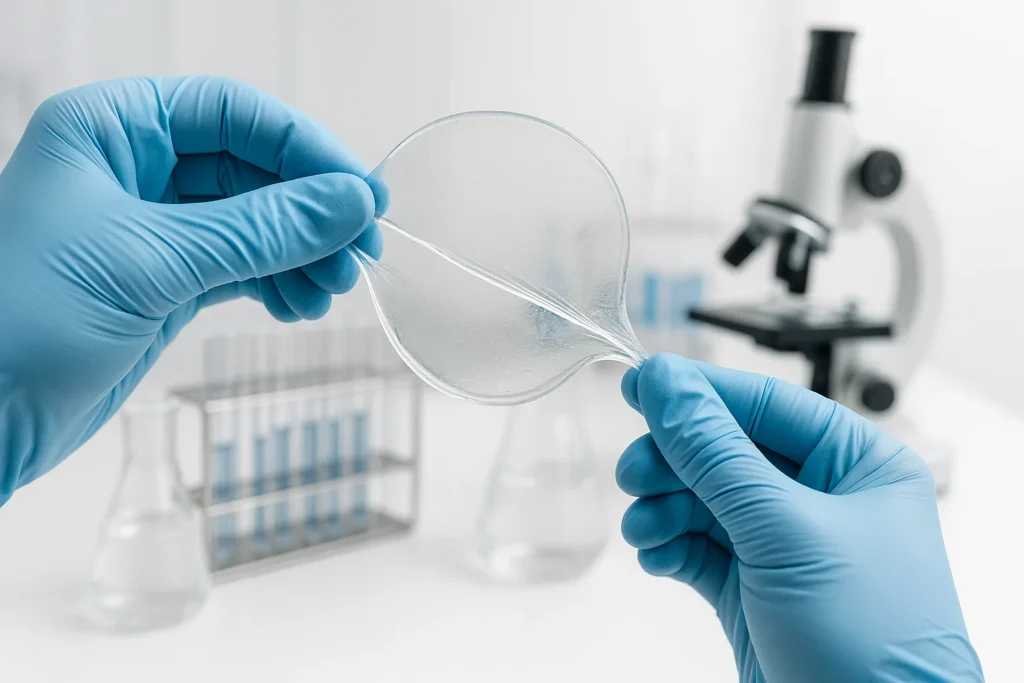
- Self-healing: minor damage repairs itself through dynamic bond reformation
- Solvent-resistant: stable when exposed to organic solvents despite being water-processable
- Nanoscale processability: can be shaped into fine structures for specialized applications
- Fully biodegradable: breaks down safely in natural environments
Why water-based recycling matters
Recycling conventional plastics, and some bioplastics too, means thermal or chemical processing that consumes energy and often degrades the material. These hydrogels avoid all of it. Submerged in water under mild conditions, the imine bonds reverse and the components separate cleanly for reuse.
That is a closed-loop material cycle running at ambient conditions, which no current recycling technology manages.
Where it could be used
Biodegradability, self-healing and nanoscale processability together suggest packaging film, biomedical scaffolds, agricultural coatings and electronic substrates. Self-healing earns its place wherever surface damage would otherwise end a product’s useful life early.
Nanoscale processing points further, toward microelectronics and sensor fabrication, where the pressure to replace petroleum-derived polymers is growing and the tolerances are tight.
From bench to production
The work is early. What favours it is the inputs: polysaccharides and DNA recovered from waste biomass are cheap and abundant, and water-based processing keeps both manufacturing cost and environmental impact below solvent-heavy alternatives.
Circularity is the property most bioplastics claim and few deliver. DNA bioplastics that come apart in water have a stronger claim than most.
FAQ
What is a DNA-polysaccharide hydrogel?
It is a bioplastic material formed by crosslinking plant-derived polysaccharides (such as dextran and cellulose derivatives) with DNA through reversible chemical bonds, creating a water-processable and recyclable gel-like plastic.
How are DNA bioplastics recycled?
They are recycled through aqueous hydrolysis, a process that uses water to reverse the chemical bonds holding the material together. The separated components can then be reformed into new material.
Are DNA bioplastics safe for the environment?
Yes. The materials are fully biodegradable and made from naturally occurring polysaccharides and DNA, so they break down without releasing harmful residues.
Can DNA bioplastics replace conventional plastics?
They show promise for packaging, biomedical, and electronics applications. However, scaling up production and matching the mechanical performance of conventional plastics in all use cases remains a research challenge.