Bioplastics have always traded performance for sustainability. Materials that biodegrade tend to soften early and break under load, which keeps them out of anything demanding. A 2025 study in Angewandte Chemie by Chen, Teng and Yang reports a class of recyclable bioplastics that gives up neither.
What makes these different
The team used organocatalyzed phenol-yne click polymerization to build poly(vinyl ether ester)s from bioderived diphenols and dipropiolates. The resulting polymers match or beat many petroleum-based engineering plastics on the numbers that matter.
The numbers
- Degradation temperatures: 329 to 362 degrees Celsius
- Tensile strengths: 41 to 89 MPa, in the range of common engineering thermoplastics
- Dynamic acetal moieties: chemical groups built in to allow controlled degradation and recycling
- Bioderived feedstocks: starting materials from renewable biomass
How the closed loop works
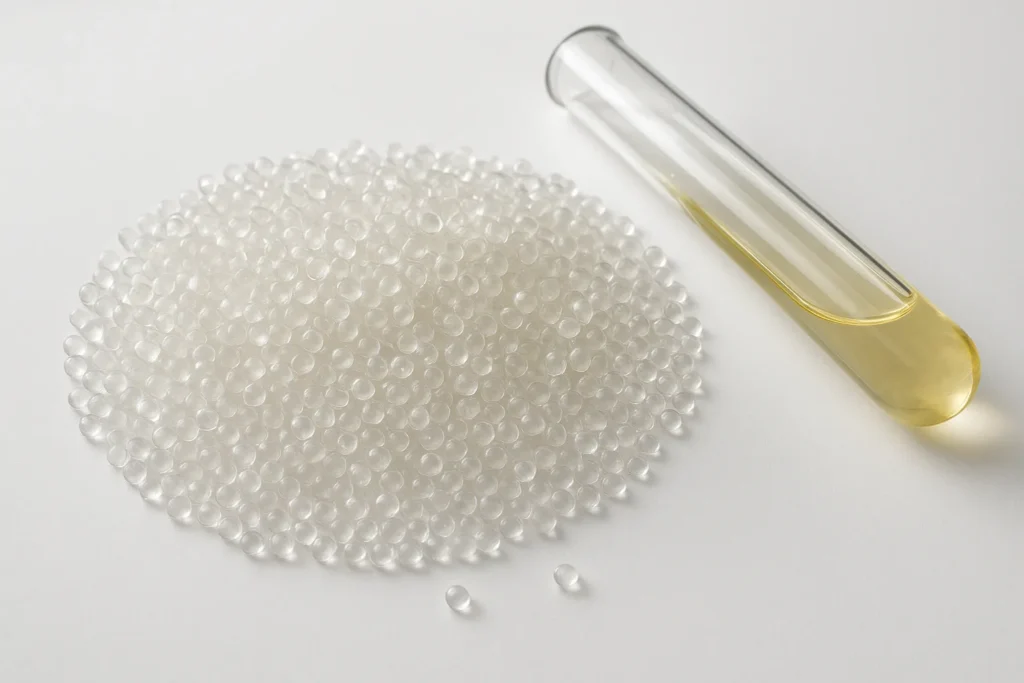
The dynamic acetal bonds in the polymer backbone are the mechanism. Under the right conditions they can be cleaved selectively, breaking the polymer back into its monomers, and those monomers repolymerize into fresh material with no loss of quality.
That is closed-loop recycling in the strict sense, not the downcycling that mechanical plastic recycling actually delivers. Every cycle returns material chemically identical to the original, so the same molecular building blocks can in principle be reused indefinitely.
Why heat resistance and strength matter
Bioplastics have been stuck in packaging film and disposable cutlery because that is what their properties allow. Degradation above 329 degrees Celsius and tensile strength reaching 89 MPa put automotive components, electronic housings and structural parts within reach.
For comparison, PLA, the most common bioplastic in use, degrades around 250 degrees Celsius at tensile strengths of 50 to 70 MPa. The gap is large enough to change which applications are open.
The catalyst matters too
Using organocatalysts instead of metal-based ones removes a problem that follows conventional polymerization: metal residues that stay in the product and complicate disposal. Organocatalysis avoids that while still giving the stereocontrol needed for consistent material properties.
How far this is from market
This is proof-of-concept work. What makes it worth watching is that bioderived feedstock, engineering-grade performance and closed-loop recycling arrive together, which is the combination that has been missing. Whether it competes with conventional engineering plastics comes down to whether the synthesis scales at a sane cost.
FAQ
What does closed-loop recyclability mean for bioplastics?
It means the polymer can be broken down into its original monomers and repolymerized into new material of identical quality, enabling theoretically infinite recycling without degradation in performance.
How strong are these recyclable bioplastics?
They achieve tensile strengths of 41 to 89 MPa, which is comparable to or better than many conventional engineering thermoplastics and significantly above standard PLA.
Are the raw materials for these bioplastics renewable?
Yes. The diphenols and dipropiolates used as starting materials are derived from renewable biomass sources.
Can these bioplastics withstand high temperatures?
Yes. Their degradation temperatures range from 329 to 362 degrees Celsius, making them suitable for applications that require significant heat resistance.