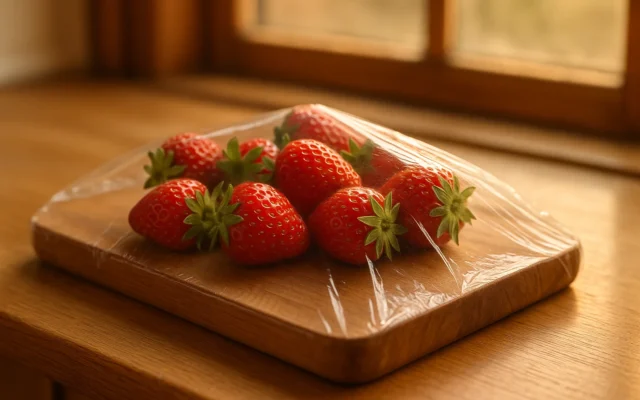
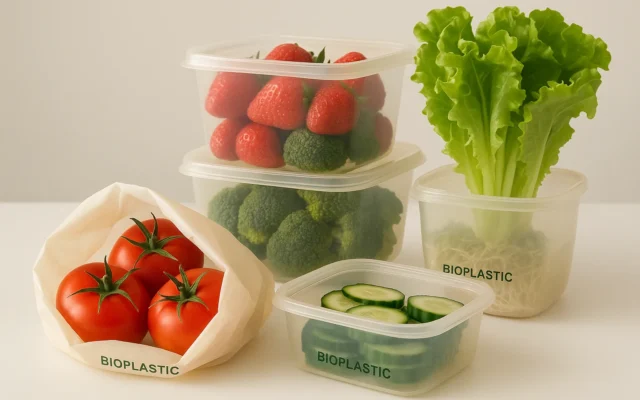
Soy processing produces huge volumes of whey, a protein-rich wastewater that costs money to treat and is normally thrown away. Researchers have turned it into transparent flexible soy waste bioplastic film at industrial scale. The proof of concept, published in Biomacromolecules (Bagnani, Peydayesh, Knapp et al., 2024), runs from food industry byproduct to finished film.
How the film is made
Soy whey carries proteins that can be converted into amyloid fibrils, nanoscale fibers with unusually good mechanical properties. Those fibrils form the structural backbone of the film.
Two more components turn that backbone into a usable material:
- Methylcellulose: a plant-derived polymer that improves film flexibility and transparency
- Glycerol: a common plasticizer that prevents the film from becoming brittle
The result is transparent, flexible and mechanically sound, which covers what packaging needs.
Proof of concept at industrial scale
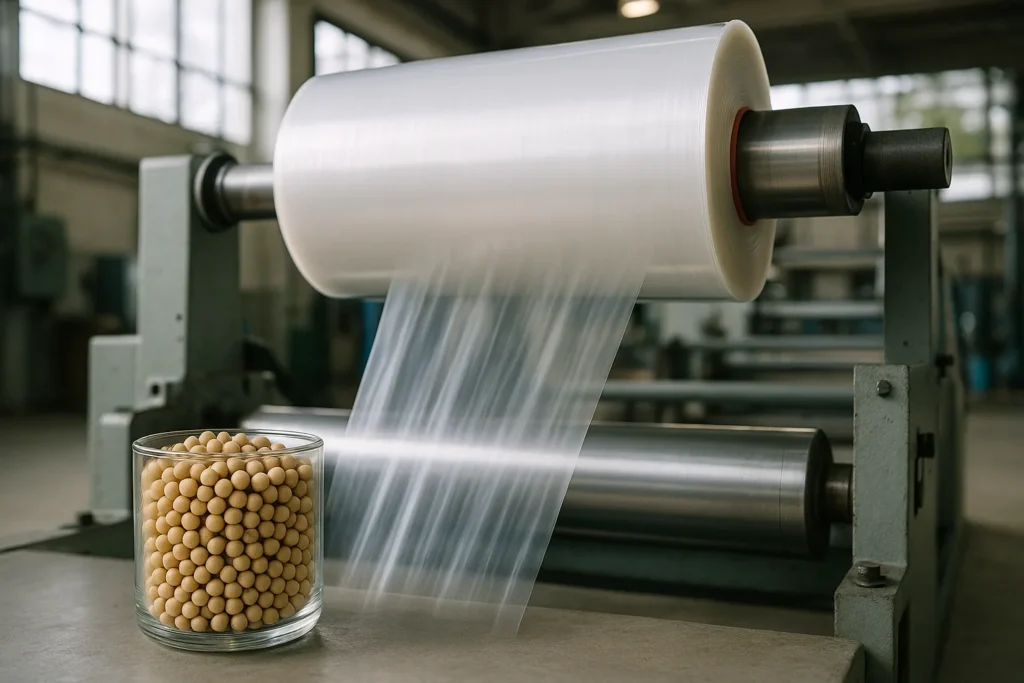
The scale is what separates this from most bioplastic research. The team processed 500 liters of soy whey and produced roughly one kilometer of continuous film, on equipment and at volumes that mean something to a manufacturer.
Plenty of promising materials never get past a benchtop sample. Producing a kilometer of film from one batch of waste answers the question that kills most of them.
Two problems, one process
Conventional plastic production burns fossil resources and leaves persistent waste. Soy whey disposal costs processors money and loads the environment at the other end. Turning one into a substitute for the other addresses both, which is why soy waste bioplastic gets attention beyond its material properties.
What it delivers
- Waste valorization: converts a costly disposal problem into a revenue-generating product
- Reduced fossil dependence: replaces petroleum-derived plastic films with bio-based alternatives
- Lower carbon footprint: uses existing waste streams rather than virgin raw materials
- Biodegradable end product: the protein-based film breaks down naturally at end of life
Whether it reaches market
Soy processing is global and runs year-round, so the feedstock is reliable in a way agricultural inputs often are not. The film is made on standard industrial equipment, which removes the usual capital barrier. For a packaging company under pressure to show certified sustainable materials, film made from food waste is also an easy thing to explain to a customer.
What remains is the ordinary work of commercialization: shelf-life data, barrier performance against specific foods, and a price that competes.
FAQ
What is soy waste bioplastic made from?
It is made from amyloid fibrils derived from soy whey (a byproduct of soy processing), combined with methylcellulose and glycerol to create flexible, transparent films.
How much bioplastic film can be made from soy waste?
In the published proof of concept, 500 liters of soy whey yielded approximately one kilometer of continuous bioplastic film.
Is soy waste bioplastic biodegradable?
Yes. The protein-based film is biodegradable and breaks down in natural environments, unlike conventional petroleum-based plastic films.
Can soy waste bioplastic be used for food packaging?
The film’s transparency, flexibility, and bio-based composition make it a strong candidate for food packaging applications, though specific food-contact certifications would need to be obtained for commercial use.