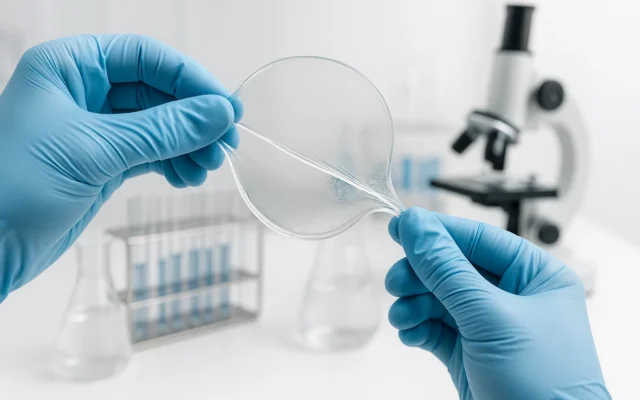
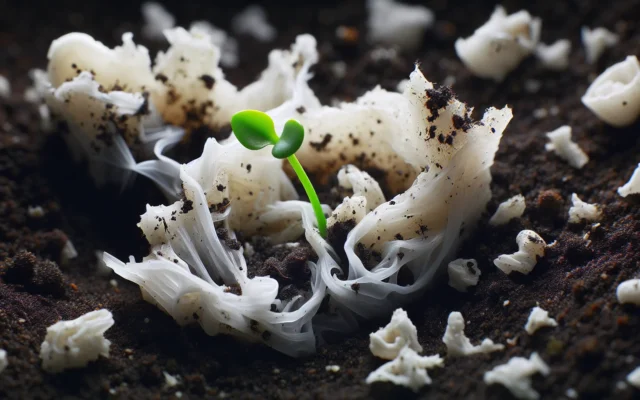
A PLA strength breakthrough published in Nature Materials reports a 30-fold increase in polylactic acid’s impact resistance, achieved through reactive compatibilization with a bio-based elastomer. The blend keeps PLA’s transparency and biodegradability while approaching the toughness of ABS, which opens durable goods to a material that has never been able to reach them.
PLA’s brittleness problem
PLA has a notched Izod impact strength around 2.5 kJ/m² against roughly 20 kJ/m² for ABS, an engineering-grade fossil-based polymer. That gap is why PLA has stayed in packaging and disposables. Earlier attempts to toughen it worked, and cost either transparency or biodegradability in the process.

How the blend works
Researchers at ETH Zurich and Wageningen University combined a bio-based thermoplastic elastomer made from plant oil fatty acids with a plant-oil chain extender. During twin-screw extrusion the chain extender forms copolymer at the interface between PLA and elastomer, producing elastomer domains of 200-400nm. At that size they absorb impact energy without scattering enough light to cloud the material.
The results: notched Izod impact strength of 75 kJ/m², a 30-fold improvement that exceeds standard ABS; tensile strength 48 MPa; light transmittance above 85%; and full disintegration under EN 13432 conditions in 90 days. It runs on standard twin-screw extruders at 170-190°C, so no new equipment is required.
What it opens up
Electronics housings, automotive interior trim, power tool casings and toys all become plausible applications. The global ABS market it would compete with exceeds 12 million tonnes, worth around $28 billion. The added material cost is $0.40-0.60/kg over standard PLA, bringing the total to $2.50-3.00/kg.
Where it stands
Patents have been filed, pilot trials at 50-100 kg batches are planned for late 2026, and licensing discussions with major PLA producers are under way. More on PLA in our Knowledge Zone.