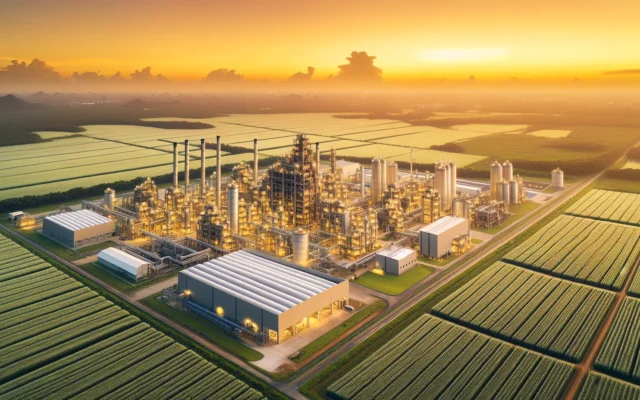
Government programs in the US, EU and Japan have committed over $180 million to algae-derived polymers. The scale of this algae bioplastics funding marks a deliberate move toward third-generation feedstocks, which sidestep the food-versus-fuel argument entirely.
Why algae
Commercial bioplastics run on corn and sugarcane, which is where the food competition objection comes from. Algae grow on non-arable land, in saltwater or in wastewater, taking CO2 as their carbon source.
The obstacle is cost. Algae-derived polymers currently run $4-8/kg against the sub-$2/kg needed to compete with conventional plastics and established bio-based polymers. Public money is aimed squarely at that gap.

Where the money is going
US DOE: $72M through the Bioenergy Technologies Office across 14 projects including NREL and UC San Diego, working on pushing PHA accumulation in microalgae past 50% of dry cell weight.
EU Horizon Europe: $68M, or EUR 63M, across three flagship projects, including harvesting technology that cuts dewatering energy by 60% and cyanobacteria engineered to replace fossil polymers.
Japan NEDO: $42M for integrated biorefineries that pair algae cultivation with industrial CO2 capture from cement and steel plants.
Commercial interest
Packaging companies have signed letters of intent with the funded consortia for off-take agreements, targeting applications in flexible food packaging, foodservice items and agricultural mulch film. The DOE’s target of below $1.80/kg would put algae PHA at parity with polyethylene, which is the number the whole field is chasing.
Timeline
Most projects run 3 to 5 years with pilot-scale results expected between 2028 and 2030. Venture-backed startups including Algix, Loliware and Algenesis are raising alongside them. More in our Knowledge Zone.