Compostable packaging is supposed to break down alongside food waste. Whether it does so in a working composting plant, rather than in a laboratory, is a separate question. A study in Bioresource Technology answered it with data from full-scale industrial composting, and the packaging performed.
How the study was run
Gastaldi E, Buendia F, Greuet P and colleagues put compostable packaging into household biowaste under full-scale windrow composting conditions, not controlled laboratory settings. That distinction is the point of the study. Laboratory compostability testing has been criticised for years on exactly this ground: passing a standard says little about surviving a real facility.
The team tracked the packaging through the whole composting cycle and analysed both how much of it broke down and what the finished compost was like.
Findings
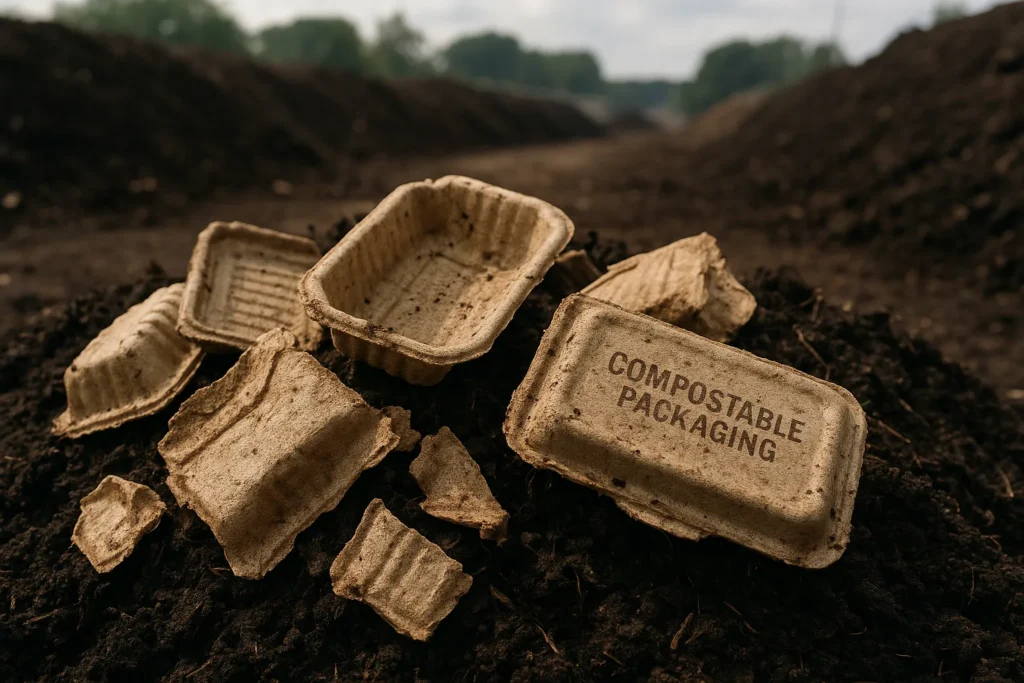
- 98% mass loss after 4 months, meaning the packaging effectively disappeared within a standard cycle
- No ecotoxicity in the resulting compost, with no harm to plant growth or soil organisms
- Better compost quality than the alternative of sending the same biowaste to incineration
- Agronomic performance confirmed when the compost was used on agricultural land
Why the numbers matter
The standing objection to compostable packaging is that it does not really break down, and the evidence offered is usually a plastic fragment in finished compost. This study meets that objection with full-scale data rather than argument.
98% mass loss is the figure that matters to a plant operator, because their concern is contamination of a product they have to sell. It says that certified compostable packaging entering a well-run facility is gone by the time the compost leaves.
What it means for waste infrastructure
- Industrial composting facilities can accept certified compostable packaging without risking their output
- Co-processing with household biowaste does not degrade compost quality
- Composting beats incineration on environmental grounds for this waste stream
- Policy on expanding organic waste collection now has evidence behind it
What the study does not settle
The materials work. The system around them is another matter, and consumer sorting accuracy, collection coverage and clear labelling all remain unsolved. A certified bag in the wrong bin behaves like any other plastic.
For a municipality or waste processor deciding whether to take compostable packaging into an organic stream, though, the material risk is now quantified rather than assumed.
Source: Gastaldi E, Buendia F, Greuet P et al. “Degradation and environmental assessment of compostable packaging mixed with biowaste in full-scale industrial composting conditions.” Bioresource Technology, 2024. Read the full study.
FAQ
Does compostable packaging actually break down in industrial composting?
Yes. This study found 98% mass loss after 4 months in full-scale industrial windrow composting, demonstrating near-complete degradation under real operating conditions.
Is the resulting compost safe to use?
The study confirmed no ecotoxicity in the finished compost and validated agronomic benefits, meaning the compost is safe and effective for agricultural use.
Can compostable packaging be composted at home?
This study examined industrial composting conditions with higher temperatures and controlled processes. Most certified compostable packaging is designed for industrial facilities, not home composting bins.
How does composting compostable packaging compare to incineration?
The study found that compost from biowaste with compostable packaging showed superior quality compared to outcomes from incineration, supporting composting as the preferred end-of-life pathway.