Bacteria fed nothing but carbon dioxide and visible light have produced biodegradable plastic in the laboratory. The study, published in the Journal of the American Chemical Society, used organic semiconductor-bacteria hybrids to drive the conversion.
How the CO₂ bioplastic bacteria hybrids work
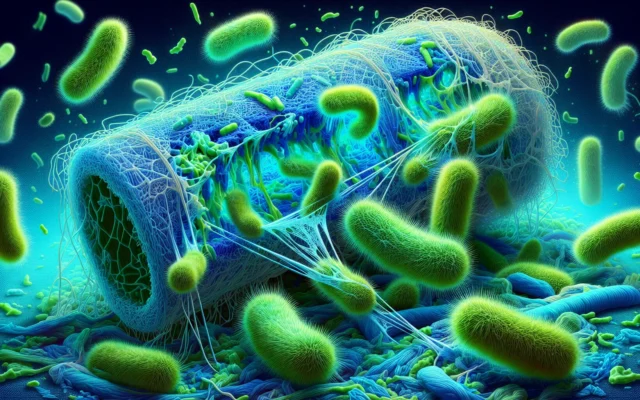
The team led by Zhang Y, Liu X and colleagues built a hybrid of organic semiconductors and Ralstonia eutropha, a nonphotosynthetic bacterium already known for producing polyhydroxyalkanoates (PHAs). Binding semiconductor nanoparticles to the bacterial surface improved transmembrane electron transfer, which is what lets a bacterium that cannot photosynthesize run on light anyway.
Under visible light the semiconductor absorbs photons and releases electrons. Those electrons cross the bacterial membrane and power the metabolic pathway that turns CO₂ into poly-β-hydroxybutyrate (PHB), a biodegradable bioplastic.
Results
- Maximum PHB yield of 107.3 mg/L/OD600, high for a light-driven biological system
- Tighter semiconductor-bacteria contact improved conversion efficiency
- A nonphotosynthetic organism performed the work, so no naturally photosynthetic strain was needed
What it changes for bioplastic production
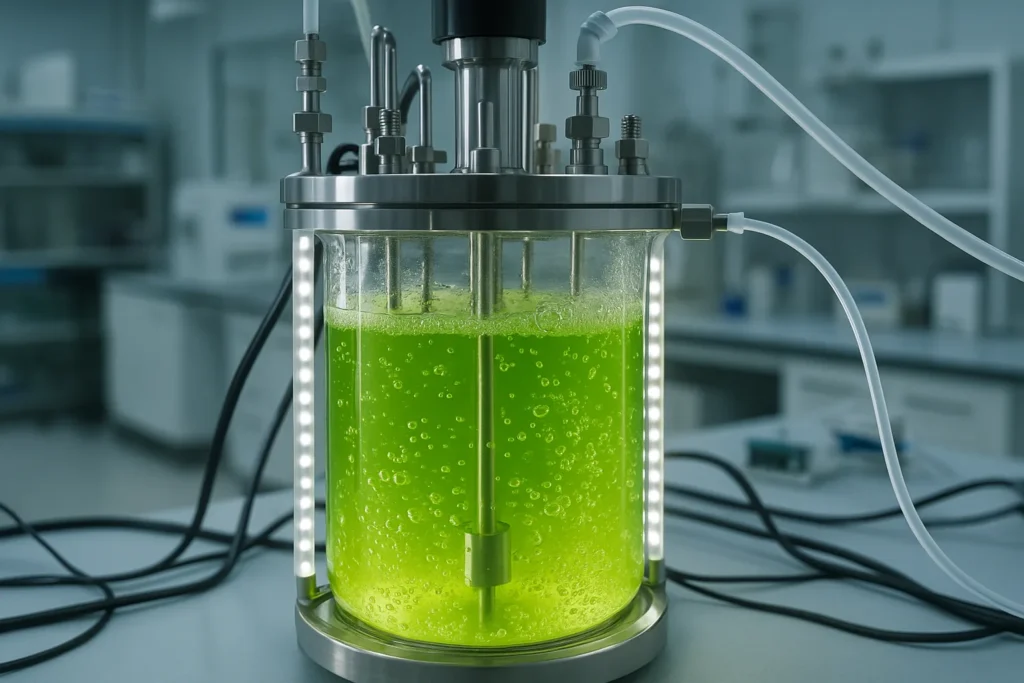
Conventional bioplastic manufacturing runs on agricultural feedstock such as corn or sugarcane, which needs land and competes with food production. This route takes a greenhouse gas as the raw material and sunlight as the energy source instead.
Ralstonia eutropha is already used in industrial PHA production, which matters more than it sounds: the organism, the fermentation equipment and the downstream processing all exist. What is new is the light-driven front end.
Possible applications
- Carbon-negative bioplastic manufacturing
- Integration with industrial CO₂ capture systems
- Decentralized bioplastic production using solar energy
- Reduction of dependence on agricultural feedstocks
What stands in the way
Three problems separate this from industrial production: keeping the semiconductor-bacteria interface stable over long runs, harvesting light efficiently outside controlled laboratory conditions, and getting the cost down at scale. All three are active research areas, and none is close to solved.
What the study establishes is that bioplastic can be made directly from CO₂ and sunlight, at a yield worth measuring.
Source: Zhang Y, Liu X, Zhang Y et al. “Binding-Enhanced Organic Semiconductor-Bacteria Hybrids for Efficient Visible Light-Driven CO₂ Conversion to Bioplastics.” Journal of the American Chemical Society, 2025. Read the full study.
FAQ
What is CO₂ bioplastic bacteria technology?
It is a hybrid system that combines organic semiconductor nanoparticles with bacteria like Ralstonia eutropha to convert carbon dioxide into biodegradable bioplastic (PHB) using visible light as an energy source.
What type of bioplastic is produced from CO₂?
The process produces poly-β-hydroxybutyrate (PHB), a member of the polyhydroxyalkanoate (PHA) family. PHB is fully biodegradable and compostable.
Is this technology ready for commercial use?
Not yet. The research demonstrates proof of concept with strong yields in laboratory conditions. Scaling to industrial production requires further development of system stability and cost efficiency.
How does this differ from traditional bioplastic production?
Traditional bioplastics use plant-based sugars as feedstock. This approach uses CO₂ directly, powered by light, eliminating competition with food crops and potentially achieving carbon-negative production.