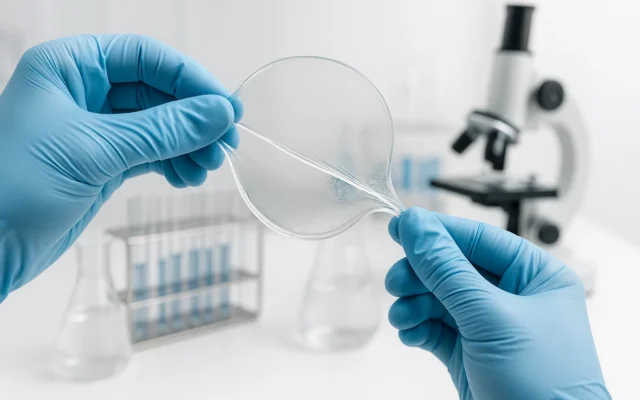
Plastic that carries the enzymes needed to digest itself is no longer hypothetical. A review in ACS Applied Bio Materials by Sun S and colleagues covers the state of enzyme embedded bioplastic, where degradation enzymes sit inside the polymer matrix from the moment it is made. The target is the oldest complaint about biodegradable plastics: what they do in a test and what they do in the ground are different things.
The problem with “biodegradable” plastics
Most people assume a biodegradable plastic such as PLA breaks down wherever it lands. PLA needs industrial composting above 58°C to degrade at any useful rate. In a landfill, in soil or in seawater it can last years, sometimes decades.
That gap costs the whole category its credibility, and it leaves plastic in places where nobody expected any. Embedding the enzyme in the material attacks the problem from a different direction.
How enzyme-embedded bioplastics work
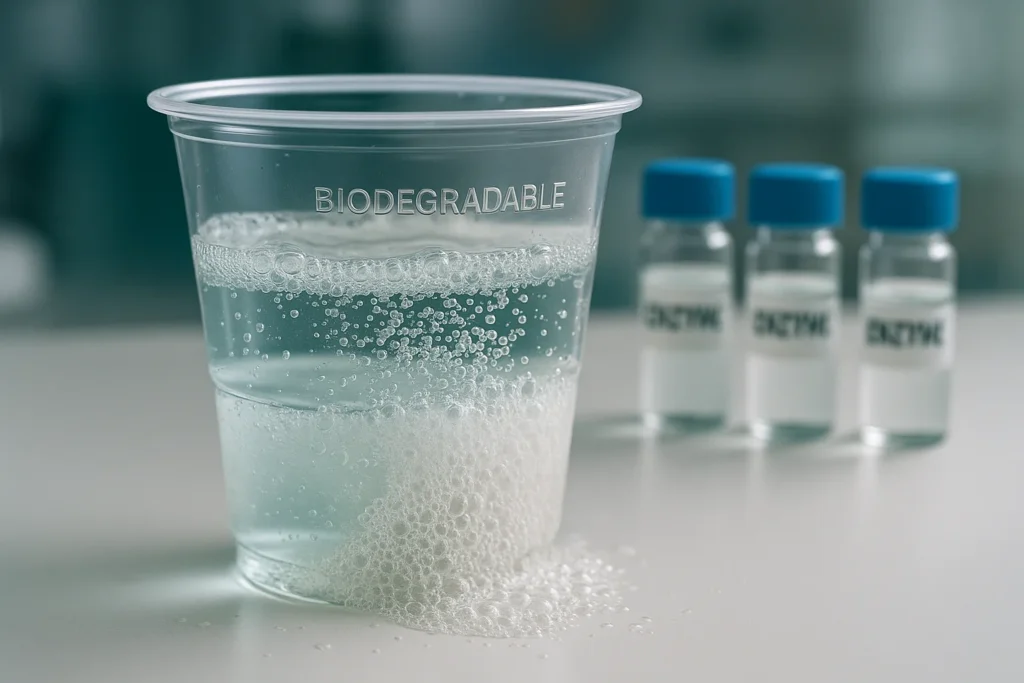
The idea is simple enough: degradation enzymes go into the polymer during manufacturing. They stay inactive through the product’s working life and switch on when the environment triggers them, through moisture, a temperature change or a shift in pH.
What that buys
- Degradation runs far faster than environmental microorganisms alone could manage
- Activation can be engineered to match the intended product lifespan
- The material no longer depends on access to an industrial composting facility
- Enzymes can be embedded in polymers already in wide use, such as PLA and PCL
What decides whether it works
The review names four factors:
- Enzyme selection: it has to degrade that specific polymer efficiently without weakening the material while the product is still in use
- Thermal stability: the enzyme has to survive polymer processing, which often runs above 150°C
- Dispersion uniformity: uneven distribution through the matrix gives uneven degradation
- Protective encapsulation: shielding the enzyme during processing while still allowing it to activate afterwards
Where it still falls short
Enzyme stability at processing temperatures remains the hardest technical problem. There is also the question of mechanical properties, since an embedded enzyme is a discontinuity in the material and discontinuities are where things break. Cost adds a third constraint: food-grade enzymes at the required purity are not cheap.
Progress in enzyme engineering and encapsulation is narrowing all three. What is at stake is plastic that degrades where it actually ends up rather than only where the standard says it should.
Source: Sun S et al. “Enzyme-Embedded Biodegradable Plastic for Sustainable Applications: Advances, Challenges, and Perspectives.” ACS Applied Bio Materials, 2025. Read the full study.
FAQ
What is enzyme embedded bioplastic?
It is a biodegradable plastic material that contains degradation enzymes built directly into its polymer structure. These enzymes activate under specific conditions to accelerate the material’s breakdown.
How fast do enzyme-embedded plastics degrade?
Degradation speed depends on the enzyme type, polymer, and environmental conditions. However, enzyme-embedded systems degrade significantly faster than conventional biodegradable plastics, often achieving complete breakdown in weeks rather than months or years.
Do the embedded enzymes affect the plastic during use?
When properly engineered, the enzymes remain inactive during the product’s useful life. Protective encapsulation and careful enzyme selection ensure that material properties are maintained until end-of-life conditions trigger degradation.
Can this technology be applied to all types of plastic?
Currently, it works best with biodegradable polymers like PLA and PCL where specific degradation enzymes are well characterized. Expanding the approach to other polymer types is an active area of research.