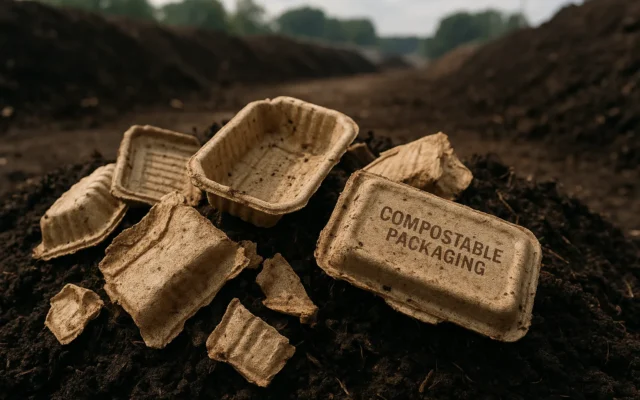
Biodegradable plastics get presented as the answer to plastic pollution. A review in Waste Management & Research by Mhaddolkar N, Astrup TF, Tischberger-Aldrian A and colleagues sets out why biodegradable plastic waste management is harder than that. The obstacles are systemic, and until they are dealt with the materials cannot deliver what is claimed for them.
The infrastructure problem
The core finding is a mismatch: many different biodegradable plastic types, each in small volume. Conventional plastics have established collection and processing streams built around a handful of polymers. Biodegradable plastics arrive as a fragmented set that no single stream handles well.
Four obstacles
- Numerous material types: PLA, PHA, PBAT, PBS, starch blends, and many others each have different degradation requirements
- Low market volumes: insufficient quantities to justify dedicated processing streams in most regions
- Sorting difficulties: biodegradable plastics are often visually indistinguishable from conventional plastics
- Contamination risks: when biodegradable plastics enter conventional recycling streams, they can compromise the quality of recycled materials
What people do with them
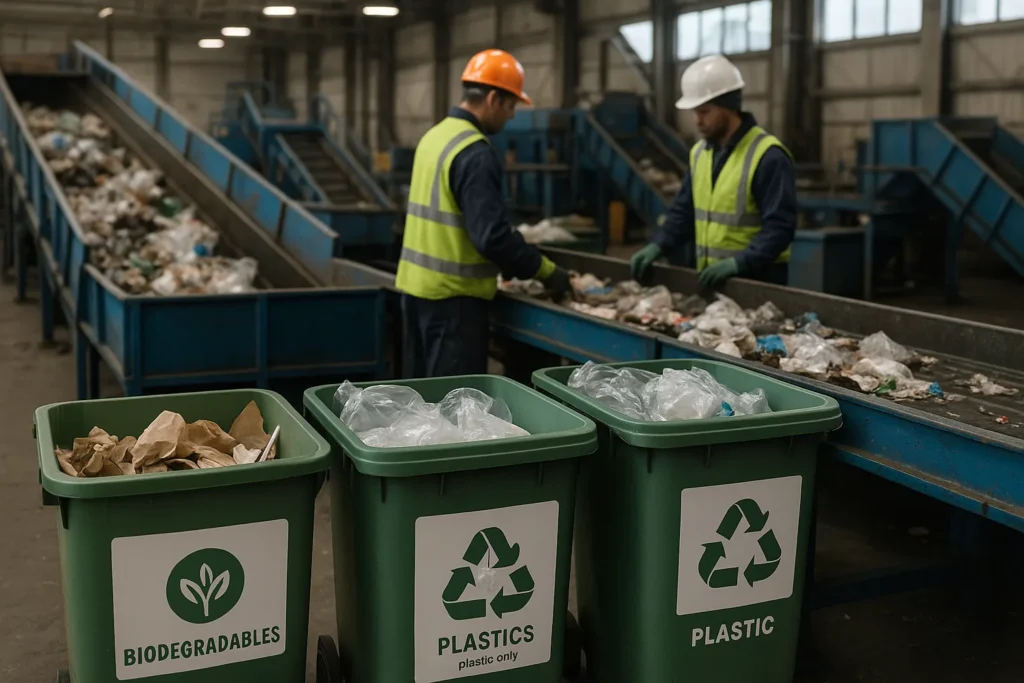
Consumer confusion about disposal is the review’s second major finding. “Biodegradable”, “compostable” and “biobased” get used interchangeably by people who then dispose of the product accordingly. Some assume littering is harmless if the item is biodegradable; others put industrially compostable packaging into a garden bin where it will sit unchanged.
Inconsistent labelling makes it worse, since disposal instructions differ between products and between countries. The result is contamination in both organic waste and conventional recycling.
Recycling barely exists
Mechanically recycling biodegradable plastics works in the laboratory and has almost no documented practice at scale. Real-world infrastructure for it is close to nonexistent, and without volumes and dedicated collection the economics do not work in most markets.
Regulatory gaps
The review identifies gaps in EU legislation and wide divergence between national rules. Source separation guidance differs between countries and between municipalities inside the same country: some accept compostable packaging in the organic bin, others explicitly forbid it.
That leaves consumers, packaging producers and waste processors each working from different assumptions. Harmonized standards would resolve most of it.
What would help
- Standardized labeling systems that clearly communicate disposal instructions
- Harmonized EU-wide regulations for biodegradable plastic collection and processing
- Investment in sorting technology capable of distinguishing biodegradable from conventional plastics
- Expansion of industrial composting infrastructure to match growing bioplastic volumes
Source: Mhaddolkar N, Astrup TF, Tischberger-Aldrian A et al. “Challenges and opportunities in managing biodegradable plastic waste: A review.” Waste Management & Research, 2025. Read the full study.
FAQ
Why is biodegradable plastic waste management so challenging?
The combination of numerous material types, low market volumes, consumer confusion about disposal, and inconsistent regulations creates systemic challenges that existing waste infrastructure is not designed to handle.
Can biodegradable plastics be recycled?
Mechanical recycling is technically possible but currently lacks scale. Dedicated collection streams and sufficient volumes are needed to make recycling economically viable.
How should consumers dispose of biodegradable plastics?
Consumers should follow the specific disposal instructions on the product label. Most certified compostable plastics should go into organic waste bins where industrial composting is available. When in doubt, check local waste management guidelines.
Are there EU regulations for biodegradable plastic waste?
EU legislation is evolving but currently has significant gaps. National regulations vary widely, and there is no harmonized EU-wide framework for the collection and processing of biodegradable plastic waste.