What if bacteria could harness light to convert carbon dioxide into bioplastic? A groundbreaking study published in the Journal of the American Chemical Society demonstrates exactly that — using organic semiconductor-bacteria hybrids to achieve visible light-driven CO₂ conversion into biodegradable plastic. This research opens a promising new chapter in sustainable materials production.
How CO₂ Bioplastic Bacteria Hybrids Work
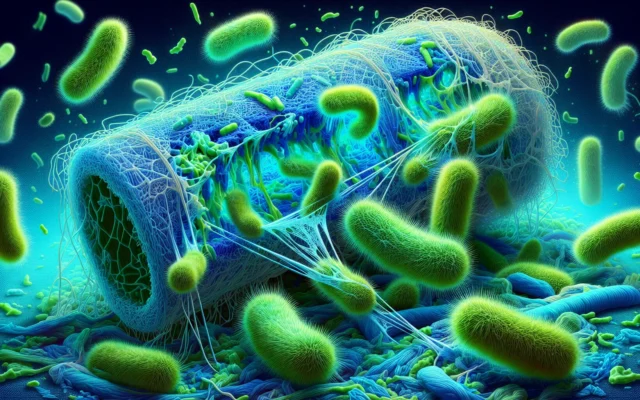
The research team led by Zhang Y, Liu X, and colleagues engineered a hybrid system combining organic semiconductors with Ralstonia eutropha, a nonphotosynthetic bacterium known for its ability to produce polyhydroxyalkanoates (PHAs). By binding organic semiconductor nanoparticles to the bacterial surface, the team enabled enhanced transmembrane electron transfer — essentially giving these bacteria the ability to perform a form of artificial photosynthesis.
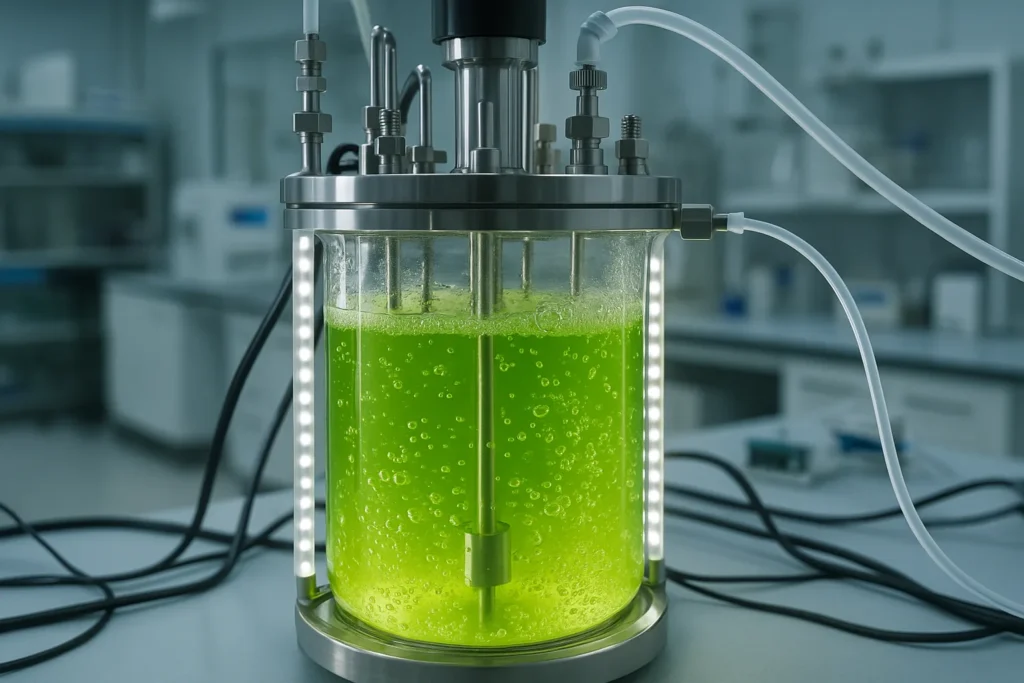
Under visible light illumination, the semiconductor absorbs photons and generates electrons. These electrons are then transferred across the bacterial membrane, powering the metabolic pathways that convert CO₂ into poly-β-hydroxybutyrate (PHB), a well-known biodegradable bioplastic.
Key Performance Results
- Maximum PHB yield: 107.3 mg/L/OD600 — a significant achievement for a light-driven biological system
- Binding-enhanced electron transfer: tighter semiconductor-bacteria contact improved conversion efficiency
- Nonphotosynthetic organisms performing photosynthesis: the hybrid approach bypasses the need for naturally photosynthetic organisms
Why This Matters for Bioplastic Production
Traditional bioplastic manufacturing relies on agricultural feedstocks like corn or sugarcane, which compete with food production and require significant land use. This CO₂ bioplastic bacteria approach offers a fundamentally different pathway — using a greenhouse gas as the raw material and sunlight as the energy source.
The ability to engineer nonphotosynthetic bacteria for light-driven production is particularly significant. Ralstonia eutropha is already used in industrial PHA production, meaning this technology could potentially integrate into existing bioprocessing infrastructure.
Potential Applications
- Carbon-negative bioplastic manufacturing
- Integration with industrial CO₂ capture systems
- Decentralized bioplastic production using solar energy
- Reduction of dependence on agricultural feedstocks
Challenges Ahead
While the results are promising, scaling this technology from the laboratory to industrial production will require overcoming several hurdles. Long-term stability of the semiconductor-bacteria interface, optimization of light harvesting under real-world conditions, and cost-effective scale-up are all active areas of ongoing research.
Still, this study represents a meaningful step toward a future where bioplastics are produced directly from CO₂ and sunlight — two of the most abundant resources on Earth.
Source: Zhang Y, Liu X, Zhang Y et al. “Binding-Enhanced Organic Semiconductor-Bacteria Hybrids for Efficient Visible Light-Driven CO₂ Conversion to Bioplastics.” Journal of the American Chemical Society, 2025. Read the full study.
FAQ
What is CO₂ bioplastic bacteria technology?
It is a hybrid system that combines organic semiconductor nanoparticles with bacteria like Ralstonia eutropha to convert carbon dioxide into biodegradable bioplastic (PHB) using visible light as an energy source.
What type of bioplastic is produced from CO₂?
The process produces poly-β-hydroxybutyrate (PHB), a member of the polyhydroxyalkanoate (PHA) family. PHB is fully biodegradable and compostable.
Is this technology ready for commercial use?
Not yet. The research demonstrates proof of concept with strong yields in laboratory conditions. Scaling to industrial production requires further development of system stability and cost efficiency.
How does this differ from traditional bioplastic production?
Traditional bioplastics use plant-based sugars as feedstock. This approach uses CO₂ directly, powered by light, eliminating competition with food crops and potentially achieving carbon-negative production.