Plastic is in the oceans, in soil and in the air, and some microorganisms have evolved to eat it. A 2024 review in FEMS Microbiology Reviews maps how they do it at the molecular level, setting out the enzymatic toolkit bacteria and fungi bring to synthetic polymers. The biochemistry of plastic biodegradation bacteria is where any biological recycling process has to start.
How bacteria colonize and break down plastic
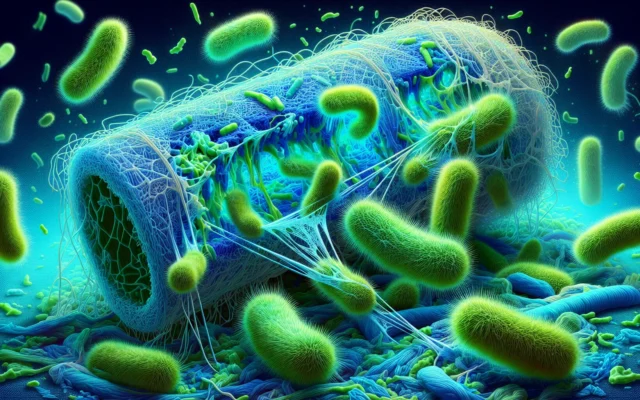
It starts when microorganisms attach to a plastic surface and build a biofilm, the community researchers call the plastisphere. Those colonies then secrete extracellular enzymes that go after the polymer chains, in three stages:
- Surface colonization: Bacteria adhere to the plastic and form biofilms.
- Enzymatic depolymerization: Secreted enzymes cleave long polymer chains into shorter oligomers and monomers.
- Uptake and metabolism: The resulting small molecules are transported into cells and fed into central metabolic pathways for energy and growth.
There is no single mechanism here. Each polymer chemistry gets its own biochemical strategy.
Pathways for the major plastics
PET (polyethylene terephthalate)
PET is the best-understood case, thanks to Ideonella sakaiensis and its PETase enzyme. PETase hydrolyzes PET into mono(2-hydroxyethyl) terephthalic acid (MHET), and MHETase then splits that into terephthalic acid and ethylene glycol, both of which bacteria can metabolize directly.
Polyethylene (PE) and polystyrene (PS)
Carbon-backbone polymers resist attack far better. Oxidative enzymes such as laccases and alkane hydroxylases start the process on PE, and PS follows similar oxidative routes. Both run much slower than PET hydrolysis and usually need UV exposure or physical weathering first to get going at all.
PLA and PHA
Polylactic acid and polyhydroxyalkanoates were designed to biodegrade, and the enzymes to do it are correspondingly common. Proteinase K and other serine proteases handle PLA; PHA depolymerases target the ester bonds in PHA. Both are widespread in soil and compost.
Where this leads
Knowing the biochemistry is what makes enzyme engineering possible, and engineered enzymes are what could turn biological recycling from a curiosity into an industrial process. Work on improved PETase variants with better thermal stability and catalytic efficiency is already well advanced.
The review is equally clear about what is missing. Complete metabolic pathways are unknown for many plastics, the environmental conditions that help or hinder degradation need much more study, and the fate of intermediate breakdown products deserves attention before anyone scales these processes up.
Source: “The biochemical mechanisms of plastic biodegradation.” FEMS Microbiology Reviews, 2024. Read the full review.
FAQ
Can bacteria fully break down plastic?
Some bacteria can fully mineralize certain plastics like PET and PHA into CO₂ and water. However, more resistant plastics like polyethylene and polystyrene are only partially degraded by known microbial processes and require further research.
What is the plastisphere?
The plastisphere is the community of microorganisms — bacteria, fungi, and algae — that colonize the surface of plastic debris in the environment, forming biofilms that can initiate biodegradation.
Which enzyme breaks down PET plastic?
PETase, first identified in the bacterium Ideonella sakaiensis, is the key enzyme that hydrolyzes PET into smaller molecules. It works alongside MHETase to complete the degradation into terephthalic acid and ethylene glycol.
How long does it take bacteria to degrade plastic?
The timeline varies enormously. Engineered PETase enzymes can degrade PET in days to weeks under optimized conditions, while natural biodegradation of polyethylene in the environment can take decades or longer.